Supernova Constraints on Dark Flavored Sectors

J. Martín-Camalich, J. Terol-Calvo, L. Tolos and R. Ziegler

Phys. Rev. D 103 (2021) L121301 (Rapid Communication)

arXiv:2012.11632 · Journal version

What it is about

A core-collapse supernova is an exceptionally powerful particle physics laboratory. A new light particle would be produced in the hot core and escape, cooling the star faster than observations allow. We applied that argument for the first time to dark sectors coupled to quark flavour, and the resulting bounds exceed the terrestrial ones over a wide range.
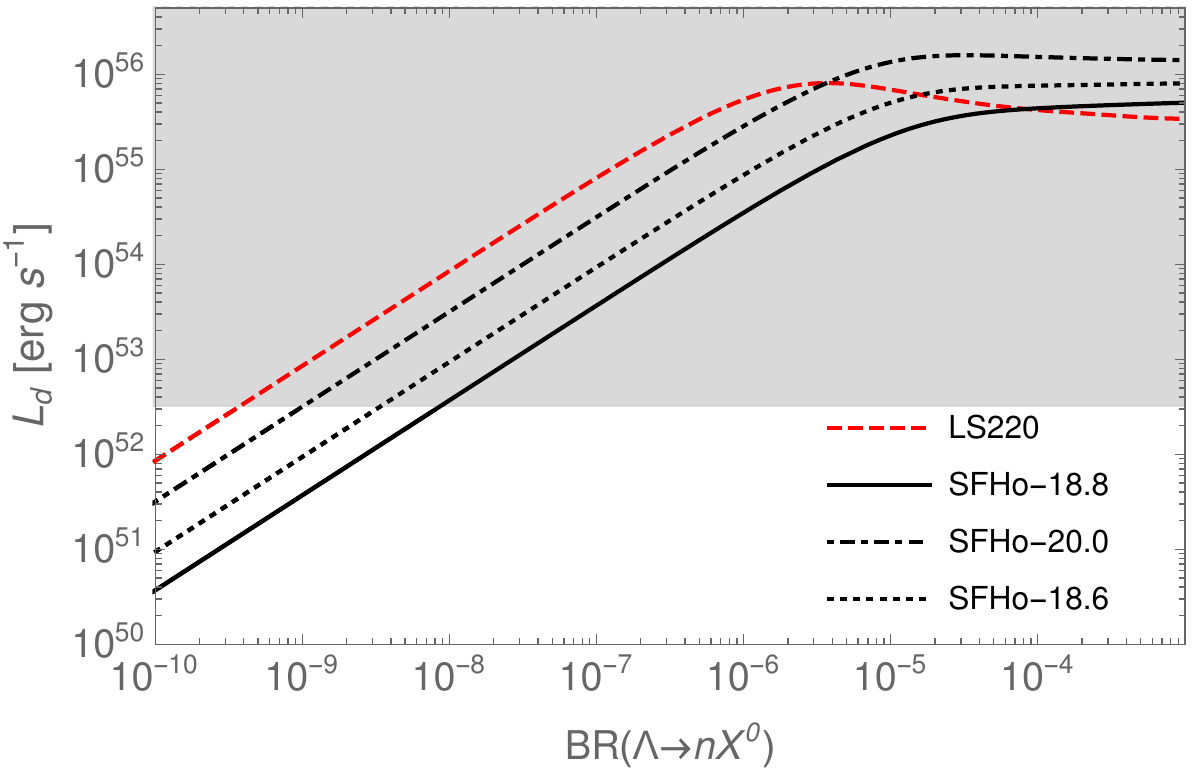
Dark luminosity for a range of SN1987A simulations at about one second post-bounce, as a function of the branching fraction of Λ → n X⁰. The grey region is excluded by the neutrino luminosity bound.

← All papers