Searching for dark-matter waves with PPTA and QUIJOTE pulsar polarimetry

A. Castillo, J. Martín-Camalich, J. Terol-Calvo, D. Blas, A. Caputo, R. T. Génova-Santos, L. Sberna, M. Peel and J. A. Rubiño-Martín

JCAP 06 (2022) 014

arXiv:2201.03422 · Journal version

What it is about

The first application of the pulsar polarimetry method, combining Parkes timing data with QUIJOTE observations from Tenerife. The later EPTA analysis grew out of this work.
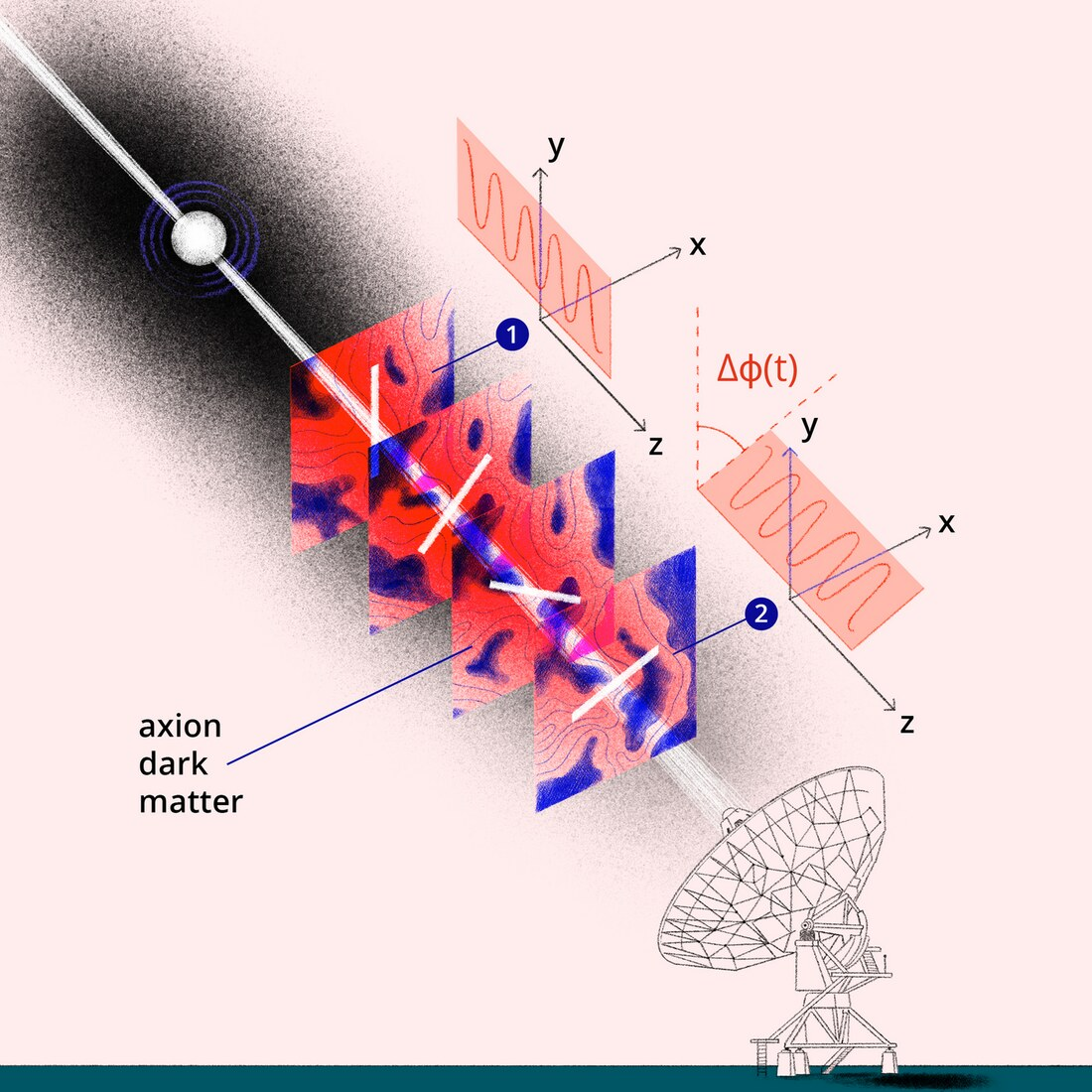
Axion dark matter behaves as a wave filling the galaxy. Polarised light leaving a pulsar (1) and arriving at a radio telescope (2) has its polarisation angle rotated by a time-dependent birefringence Δφ(t). Illustration by Ève Barlier.

← All papers